UML Activity Diagram
Note
In a video game you follow a sequence of levels to reach a goal, moving between levels with each level serving a specific purpose. Some games follow a sequential path between levels with others having branching paths offering different challenges.
When you release a game to multiple people, players participate concurrently in their own instances. UML activity Diagrams represent the control flow between activities in the system, much like the flow between the levels in a game.
The purpose of an activity diagram is to capture the dynamic behavior of the system; How control flows from one activity to the other, activity diagrams allow you to map out branching paths into alternative flows.
when creating an activity diagram as shown below, you need to identify:
- Activities : Activities are the actions that further the execution flow of your system, like creating new objects or altering existing ones.
- Conditions : Decisions made to alter the flow by deciding which activity is next
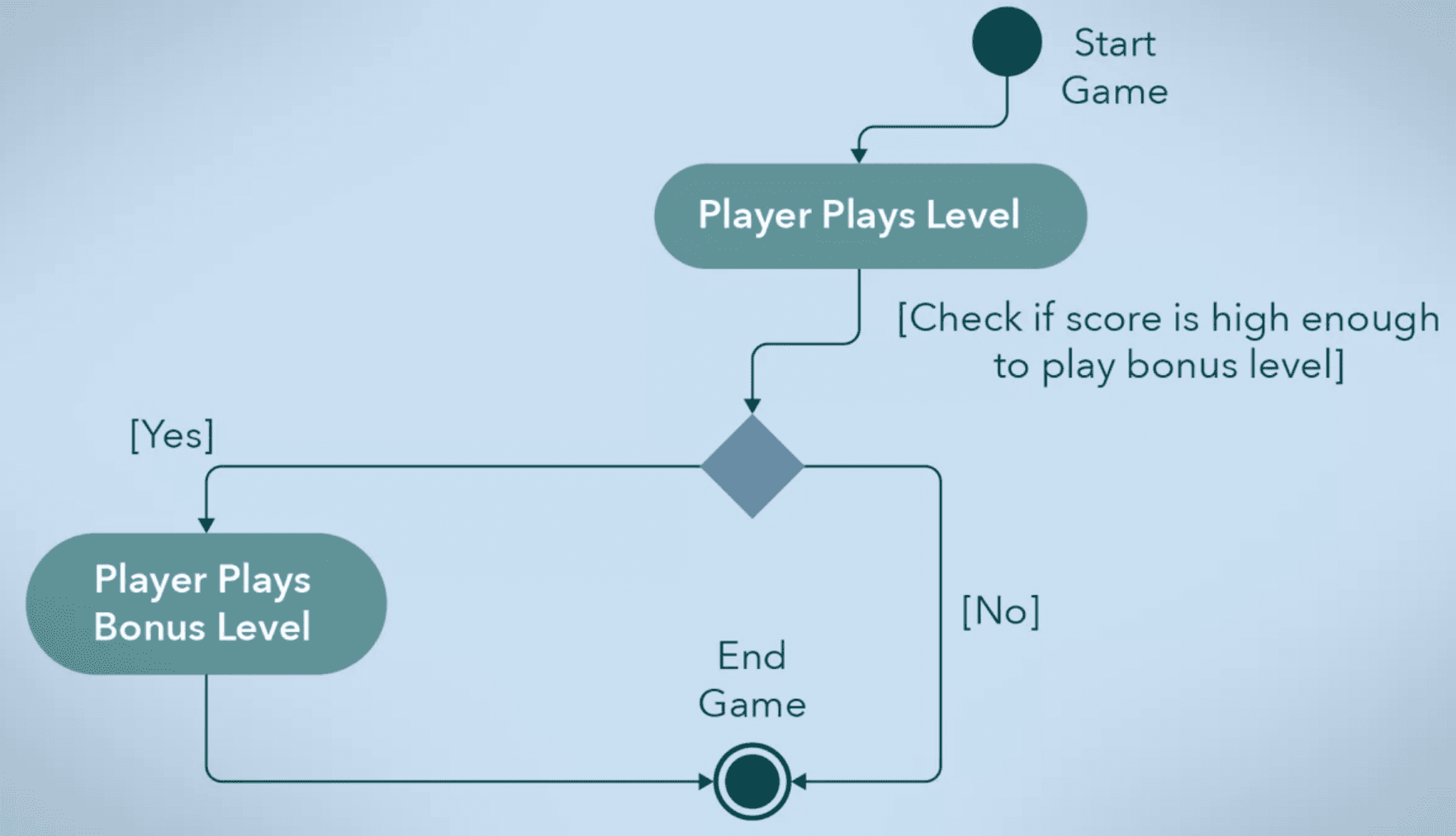
The starting point which is playing the game allow the player to play a level, once complete the player faces a condition "is the score high enough to play the bonus level ?".
if the answer is yes, the player can now play the bonus level and finishes the game if not.
Activity diagrams allow you to map out high level behaviors of a system, they do not care about implementation or code, and merely focus on the control flow between actions.
With these diagrams, you can pinpoint exactly what activities and conditions should be included, and get a better idea of the order in which features are encountered, while still taking into account, alternative flows for your system.
